
JACARDI
EU Joint Action on Cardiovascular Disease and Diabetes
Do not miss
EU Joint Action on Cardiovascular Disease and Diabetes

JACARDI is an opportunity supporting Slovenia to become faster and more effective in reducing the burden of cardiovascular diseases and diabetes.

Link to website: https://jacardi.eu/
Follow us on social media: www.facebook.com/nijz.si/
www.linkedin.com/company/nacionalni-inštitut-za-javno-zdravje-nijz/
Background
Cardiovascular diseases (CVDs) are a leading cause of death in the European Union (EU), since they affect approximately 63 million people. The prevalence of diabetes mellitus (DM) has also increased significantly, as the number of adults living with the disease nearly doubled over the past decade reaching 32.3 million in 2019. These chronic diseases pose a major threat to individual health and well-being, while also burdening the healthcare systems and hindering social and economic development.
The aim of Joint Action on Cardiovascular Disease and Diabetes (JACARDI) is to reduce the burden of these diseases in EU countries – at both individual and social levels. It is designed to bring together proven best practices or (cost-)effective measures among countries and regions through transnational pilot initiatives, complementing and reinforcing existing policies and programmes. It comprises the entire patient experience: from improving health literacy and awareness of CVD/DM, data collection and its meaningful use and availability, screening and primary prevention among high-risk populations to the patient’s pathway through the healthcare system (establishing contact with people living with CVD/DM and their care providers), improving access to services, self-management, and participation in the labour market. Joint Action also addresses cross-cutting and intersecting issues such as promoting equality in health, social, cultural, and ethnic diversity, and above all, developing practices and measures whose impact will not fade away after JACARDI ends, but whose results will be embedded in countries’ health systems and policies. The project will strengthen transnational cooperation, maximise the use of experience gained through a clear strategy, involve stakeholders and promote sustainable approaches to achieving high-level goals, including through effective cooperation and co-creation between science and politics.
Purpose of the project
Project objectives
JACARDI will test and offer solutions for the entire patient pathway, including prevention, early detection, treatment, care and self-care, in order to achieve the following objectives:
Phases of the project and their realisation
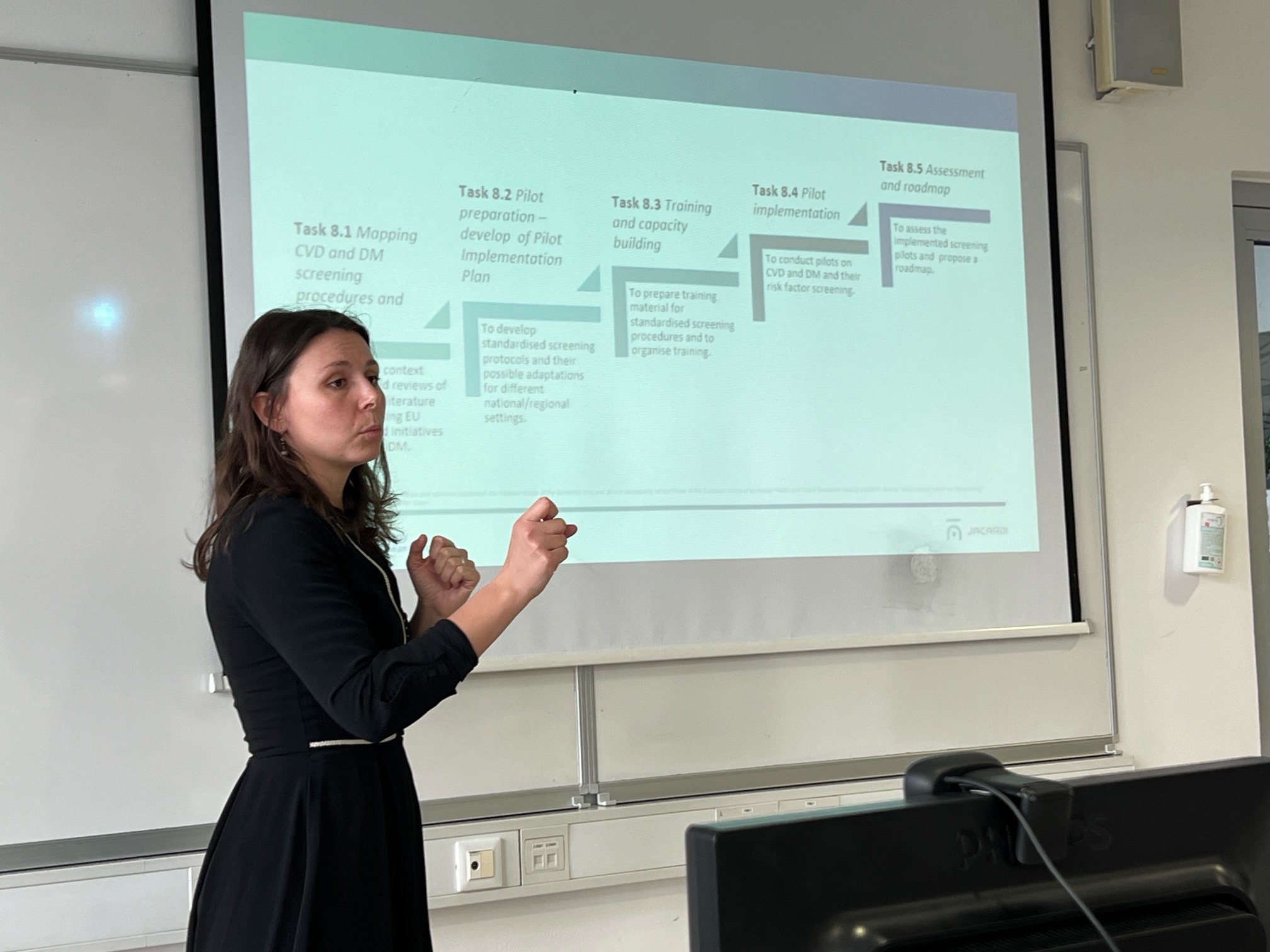
JACARDI comprises 11 work packages and 143 pilot projects covering six working areas: health literacy, data collection and use, screening, patient pathway, self-management and inclusion of people with chronic diseases into working environment.
First year of the project: Development of a uniform methodology for the implementation of pilot projects, including the development of their sustainability at the level of the entire consortium. Establishment of teams and teamwork in pilot environments, situation analysis, setting of objectives and implementation plan.
Second year of the project: Implementation in pilot environments according to the plan, interim evaluation and correction of the plan. At the consortium level, supporting capacity building.
Third year of the project: Implementation in pilot environments according to upgraded plans, final evaluation and preparations for the process that will ensure the sustainability of results in line with capacity development.
Fourth years of the project: Leading the process of preparing action plans for sustainability and intensive communication with key stakeholders in pilot environments. Supporting sustainability, intensive communication, and reporting.
Added value
Expected results and materials
Duration of the project: From November 1 2023 until October 31 2027.
Leading organisation: ISTITUTO SUPERIORE DI SANITA (ISS), Italy.
Project partners: The initiative comprises 21 European countries, including Ukraine, 76 partners and over 300 public health experts.
Funding: The project is co-funded by the Republic of Slovenia, Ministry of Health, and the European Union from the Health Programme of the European Union in the framework of the Grant Agreement no. 101126953.
Disclaimer
Views and opinions expressed in this document are those of the author(s) only and do not necessarily reflect the views and opinions of the European Union or the European Health and Digital Executive Agency (HaDEA). Neither the European Union nor the granting authority can be held responsible for them.


Using knowledge to achieve better health.